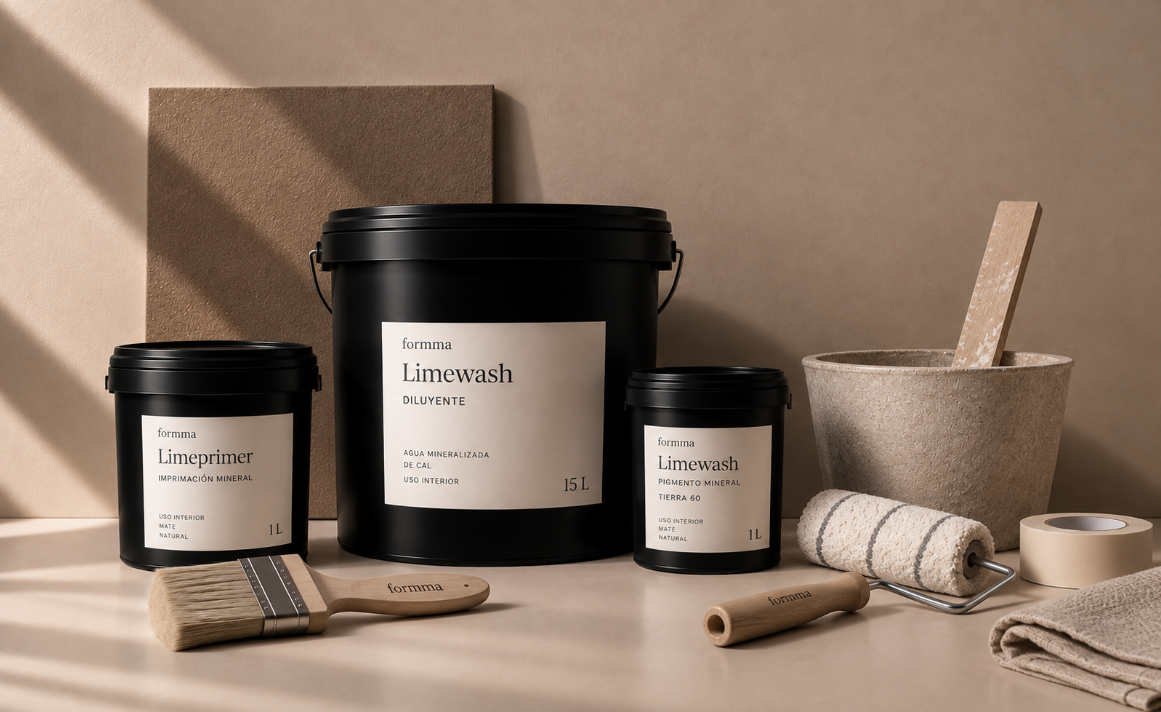
Substrate preparation, the tool and the method of application all play a part in the final result. Select a product to see its step-by-step application process.
Select a product
LIMEWASH
Lime glaze paint
Limewash is a matte, translucent lime paint that creates depth through overlapping brushstrokes and small natural variations in density. Its final expression depends on the substrate, the load of product, the direction of application and the overlap of the passes.
Tool
Flat brush
Coats
2 applications
Coverage
0.15 L/m² total · 2 coats
Components
Limewash Pigment · Limewash Base
Ratio
1:10
Finish
Translucent · Mineral · Breathable · Variable
Pared interior✓
Pared exterior✓
Techo✓
Zona húmeda sin agua directa✓
Agua directa—
Suelo—
Limewash
Flat brush
Clean container
Mixing tool
Tape / protection
Limeprimer
01 · PREPARAR
Prepare the substrate
The substrate must be sound, dry and clean. If a uniform base is required: Limeprimer where applicable + Limepaint; use Limedolomite instead of Limepaint for more body.
Continuous plaster, sound and uniform
Application on a properly prepared substrate with uniform absorption.
Prepared plasterLimewash
If there are repairs or differences in absorption, apply Limeprimer first.
As this is a translucent finish, the condition and colour of the base affect the final perception.
Uniform absorption and a surface with no visible repairs.
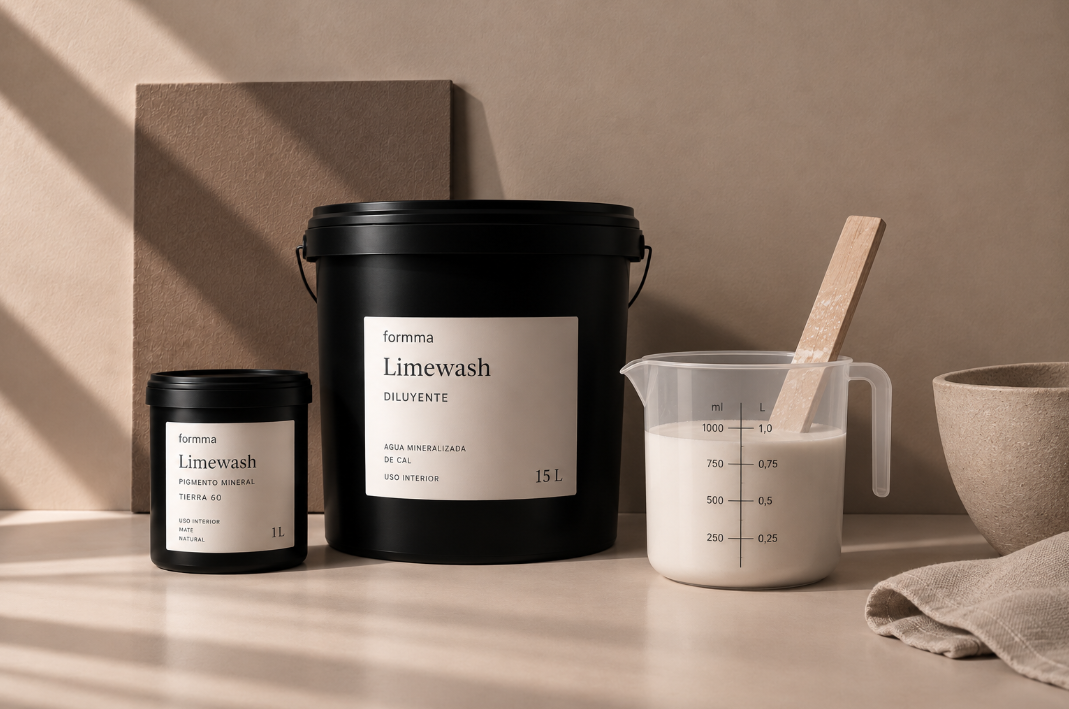
Prepare Limewash
Mix Limewash Pigment + Limewash Base for 1 minute in a 1:10 ratio until you obtain a uniform product ready for application.
Keep the product uniform during application and always use the same preparation criteria for the whole area.
Limewash Pigment + Limewash Base · 1 min · 1:10
02 · APLICAR
The brushstroke builds the glaze
2 applications · Flat brush
Apply Limewash with a flat brush, working continuously and keeping a natural brushstroke scale. The load, direction and overlap of the passes determine the final transparency, depth and movement of the surface.
Application in two coats
01 · Primera application
Apply Limewash continuously with the flat brush, keeping a controlled load and extending each brushstroke to progressively release the product.
Work in complete sections and avoid interruptions that could create visible breaks or build-up.
The brushstroke must keep the true scale of the tool.
First application→6 h→Second application
02 · Segunda application
After 6 hours, apply the second coat with the flat brush keeping the same working criteria.
Control the load and overlap: do not deliberately try to create marks. Variation should appear as a natural consequence of the application.
03 · TEXTURAS
One glaze. Different movements.
The direction, overlap and load of the brushstroke change the final reading of Limewash without changing the nature of the material. Application allows control from calmer surfaces to expressions with more movement.
TEXTURA 01
Vertical brushstroke
Herramienta Flat brush
Work with predominantly vertical passes, starting each brushstroke with a controlled load and releasing the product progressively along the stroke. Overlap the passes naturally, avoiding regular bands.
More directional · Calm · Vertical
TEXTURA 02
Cross brushstroke
Herramienta Flat brush
Gently alternate the direction of the passes and overlap the brushstrokes in an irregular, controlled way. The overlap changes the density of the glaze and creates a surface with more movement.
More movement · Greater overlap · More expressive glaze
04 · COMPROBAR
Resultado esperado
Limewash creates a matte, mineral, translucent surface, with depth built up through overlapping glazes. Small variations in density and tone allow the hand application to be read without turning the surface into a decorative effect.
Matte · Mineral · Translucent · Deep
Natural variations of the material
The mineral nature of Limewash, substrate absorption and hand application can produce small variations in density, transparency and tonal perception. These variations are part of the finish's own expression.
Avoid these mistakes
01Uneven base
Differences in colour, texture or absorption of the substrate can become visible through a translucent finish.
02Excess product
An excessive load or localised build-up can create marks, breaks or overly opaque areas.
03Brushstroke out of scale
Excessively large, regular or repetitive passes can turn the natural glaze into an artificial decorative pattern.
Validate before you start
Produce a sample on a representative substrate using the same preparation, colour, substrate, tool, number of applications and gesture planned for the project.
The sample must validate the complete system, not just the colour.